
Continuous Computer Labels: Why Some Warehouses Still Rely on This Format Over Modern Printers
Posted by : Mercury Labels Ltd on Friday, July 31, 2026 in Continuous Computer Labels.
Walk into most
modern offices and you will struggle to find anything resembling a dot matrix
printer. Walk into a working warehouse, particularly one running a distribution
operation that has been in place for a decade or more, and there is a fair
chance you will find one still churning out labels at the end of a picking
line. This is not nostalgia. It is a decision that, for a specific type of
operation, still makes sound commercial sense.
What continuous computer labels actually are
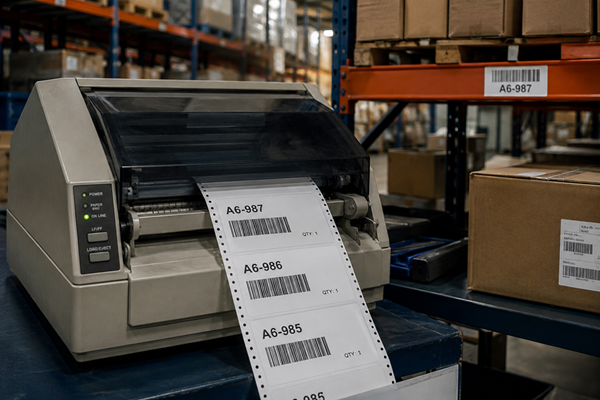
Continuous computer labels are supplied as a single unbroken reel or
fanfold stack rather than as individual pre-cut sheets. Each label sits on a
continuous backing strip, often with sprocket holes or pin-feed edges running
down either side. This feed system is what allows older dot matrix and line
printers to pull the stock through mechanically, rather than relying on the
friction or vacuum feed mechanisms found in modern desktop or thermal printers.
The format was
built for one purpose: uninterrupted, high-speed output without a human needing
to reload single sheets every few seconds. That purpose has not gone away, even
if the printers people associate with it have largely disappeared from everyday
use.
Why warehouses have not switched over
The hardware
already works. A dot matrix
or line printer connected to a legacy warehouse management system represents a
sunk cost that was often paid off years ago. Replacing functioning hardware
purely to modernise, when the current setup does the job reliably, is difficult
to justify to a finance director who is looking at the bottom line rather than
the printer's age.
Legacy systems
expect this output. Many
distribution centres still run warehouse management or stock control software
built decades ago on platforms such as AS/400 or older COBOL-based systems.
These systems were designed to send print jobs directly to pin-feed printers
using serial or parallel connections. Rebuilding that integration to work with
thermal or laser printers is a software project in its own right, not simply a
hardware swap.
Volume matters
more than appearance. In a
warehouse setting, a label rarely needs to look impressive. It needs a barcode
that scans first time, an SKU that is legible, and a printer that can produce
thousands of them per shift without jamming. Continuous computer labels, run
through the right printer, are built for exactly that kind of repetitive,
high-volume task.
They tolerate
the environment. Warehouses
are dusty, and temperatures swing between loading bay doors and heated office
areas. Dot matrix printers are mechanically simple, with fewer components that
fail when conditions are less than ideal, compared with thermal print heads
that are more sensitive to dust and heat.
Where continuous computer labels fall short
This format is not
the right answer everywhere, and it is worth being direct about the limits.
Print quality is
functional rather than sharp. Dot matrix output does not compare to laser or
thermal transfer printing for fine detail, and colour is generally not an
option. Barcodes need to be sized correctly to remain scannable, since the dot
pattern can blur finer barcode types at small sizes. For any label that faces
the customer, carries branding, or needs to survive damp or abrasive
conditions, other formats such as thermal transfer or gloss printed labels will
outperform this one.
Deciding whether to stick with continuous labels or move on
The decision
usually comes down to three questions. Is the current printer still reliable,
or is it starting to need frequent repairs? Does the label need to do anything
beyond carrying a barcode and basic text, such as displaying colour or
branding? And would switching require rebuilding software integrations, or is
it a straightforward hardware swap?
If the answer to
the first question is that the printer is ageing and increasingly unreliable,
and the third question reveals that a swap would be simple, it is often worth
reviewing thermal alternatives even where the format has served well
historically. If the current setup is stable and the labels only need to carry
operational data, there is little commercial reason to change something that is
not causing a problem.
Getting the right continuous labels for your operation
Continuous computer
labels are still manufactured in a range of widths, lengths, and adhesive
strengths to suit different printer models and applications, from single-label
rows to multi-part stationery used alongside delivery paperwork. Mercury Labels
supplies continuous computer labels sized and specified to match existing
printer setups, and can advise on stock choice where an operation is weighing
up sticking with its current system against moving to a different label format.