
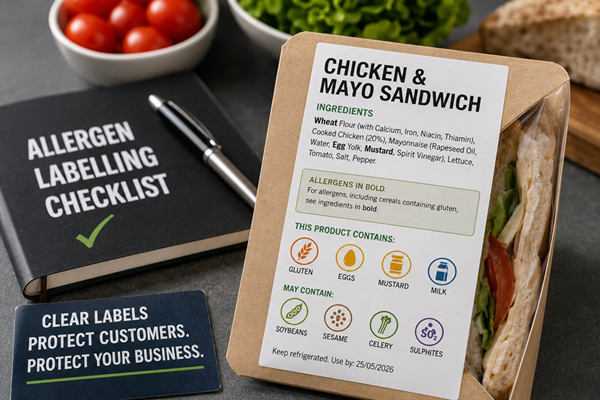
Allergen Labelling Rules for Food and Drink Products: What UK Businesses Need to Know
Posted by : Mercury Labels Ltd on Monday, July 13, 2026 in Choosing Your Labels.
For any business
producing food or drink, the label is not just branding. It is a legal
document. Get it wrong and the consequences go far beyond a poor customer
review: allergic reactions, product recalls, regulatory action, and lasting
damage to a brand's reputation are all on the table. Understanding what UK law
requires, and building labels that meet those requirements without compromising
on shelf appeal, is one of the most important jobs a food or drink producer
has.
This guide sets out
the current rules on allergen labelling, explains Natasha's Law and who it
applies to, and highlights the mistakes that most commonly catch businesses
out.
The 14 allergens you must declare
UK food law
requires businesses to identify fourteen allergens whenever they are used as an
ingredient, no matter how small the quantity. These are:
- Celery
- Cereals containing gluten (wheat, rye,
barley, oats) - Crustaceans
- Eggs
- Fish
- Lupin
- Milk
- Molluscs
- Mustard
- Peanuts
- Sesame
- Soybeans
- Sulphur dioxide and sulphites (above 10mg/kg
or 10mg/litre) - Tree nuts
If any of these
appear in a recipe, whether as a headline ingredient or a trace component of
something else you have bought in, they must be declared. There is no threshold
below which an allergen can be left off the label, sulphites aside.
Natasha's law: What changed and who it affects
Natasha's Law came
into force in October 2021, following the death of Natasha Ednan-Laperouse
after eating a sandwich that contained sesame not listed on its packaging. It
closed a significant gap in the previous rules by bringing pre-packed for
direct sale (PPDS) products into full labelling requirements for the first
time.
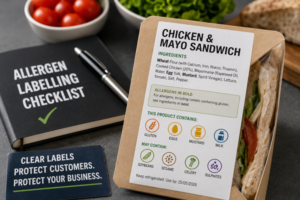
PPDS covers food
that is prepared, packed, and offered for sale on the same premises, and in the
same form it will be sold in, before a customer orders it. A sandwich made
in-store and placed in a chiller cabinet is a textbook example. Before
Natasha's Law, this kind of product only needed a verbal or written allergen
statement available on request. Now, it needs a full ingredients list with the
fourteen allergens legally emphasised, applied directly to the packaging.
This applies to
bakeries, delis, cafes, farm shops, food trucks, and any food-to-go operation.
If your business packs food on site ahead of sale, this legislation applies to
you.
What must appear on the label
For most pre-packed
food, the label needs:
- A full list of ingredients, in descending
order of weight - Each of the fourteen allergens clearly
emphasised within that list, typically through bold, a different colour, or
underlining, so it stands apart from the rest of the text - Consistent emphasis throughout, since
switching methods partway down the list undermines the point of the requirement - Sufficient contrast and font size for the
information to be genuinely legible, not just technically present
This last point is
where labelling law and label production meet directly. A compliant ingredients
list printed in a font too small to read, or on a material where ink bleeds or
fades, is not doing its job even if the wording itself is correct. Legibility
standards under UK food information regulations require a minimum font size
relative to the label's surface area, and this becomes a genuine constraint on
packaging design for smaller products.
Common mistakes that lead to recalls
Most
allergen-related product recalls do not come from a business ignoring the rules
entirely. They come from smaller failures:
- A recipe change that introduces a new allergen
without the label being updated - Inconsistent emphasis, where an allergen is
bolded in one part of the ingredients list but not another - Supplier ingredient changes that are not
communicated down the chain before packaging is printed - Text that is technically present but too
small to be genuinely readable - PPDS products treated as loose or
non-prepacked, missing full labelling entirely
Every one of these
is a process failure rather than a knowledge failure. The rules are generally
well understood. What catches businesses out is a gap between what changes on
the production line and what is reflected on the label.
Getting the label right, not just the wording
Compliance does not
stop at correct text. The material and print quality of the label affect
whether that text stays legible for the lifetime of the product. Labels on
chilled or frozen food need to withstand condensation and low temperatures
without the print smudging or the label lifting, which is covered in our guide
to label materials for chilled,
frozen and outdoor use. For
products going straight into cold storage, our freezer labels guide covers the specific material and adhesive
considerations involved.
For food and drink
producers weighing up how to manage frequent recipe or ingredient changes, our
comparison of custom labels versus pre-printed
labels is worth reading
alongside this piece, since fixed pre-printed stock makes it far harder to
respond quickly when an allergen declaration needs to change. Many food and
drink businesses also print batch numbers and traceability codes alongside
allergen information, which our guide to barcode labels and variable data explains in more detail.
How Mercury Labels can help
We work with food
and drink producers across the country to make sure allergen information is not
just present but genuinely legible, durable, and consistent across every
product line. Whether you are labelling PPDS items for the first time or
reviewing an existing range after a recipe change, we can help you specify
materials, finishes, and print processes that keep your labels compliant and
looking the part.
Get in touch with
our team to discuss your food and drink labelling requirements.