
What Label Material do you Need for Chilled, Frozen, Wet or Outdoor Products?
Posted by : Mercury Labels Ltd on Wednesday, May 13, 2026 in Choosing Your Labels.
Labels don’t usually fail immediately.
They fail once the product enters the real world.
In chilled storage, they start to lift. In freezers, they
lose adhesion completely. In wet environments, ink begins to run. Outdoors,
labels fade, crack, or break down over time.
At that point, the assumption is often that the label itself
was low quality.
In reality, the issue is usually much simpler.
The material wasn’t suited to the environment it was placed
in.
Why standard labels fail in these conditions
Most standard labels are designed for general indoor use.
They’re not built to handle temperature extremes, moisture,
or prolonged exposure to changing conditions.
Adhesives behave differently in cold environments. Moisture
interferes with bonding. Paper materials absorb water and degrade. Heat and UV
exposure weaken both the material and the print.
When labels fail in these situations, it isn’t
unpredictable.
It’s the result of using a material that wasn’t designed for
that environment.
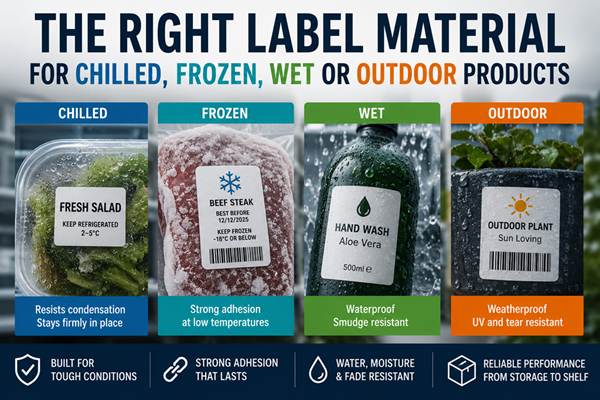
Chilled environments (fridges and cold storage)
Chilled environments introduce one major issue:
condensation.
Even if a label is applied correctly, moisture can form on
the surface before or after application. This interferes with adhesion and can
cause labels to lift over time.
Standard adhesives often struggle to maintain a secure bond
in chilled conditions, particularly on smooth packaging surfaces such as
plastic or glass.
Materials used in chilled environments need to tolerate both
low temperatures and ongoing moisture exposure without peeling, degrading, or
losing readability.
Frozen environments (freezers and deep freeze logistics)
Freezers present a different set of challenges.
At very low temperatures, many adhesives lose their ability
to bond effectively. Labels can become brittle, reducing flexibility and
increasing the risk of cracking or detachment.
Applying labels before freezing only works if the material
and adhesive are specifically designed for frozen conditions.
For example, online butchers and frozen food suppliers often
ship raw, perishable products that may be immediately frozen or packed in dry
ice during transit. In these situations, specialised deep freeze adhesives are
essential to ensure the label remains securely bonded throughout the entire
delivery process.
Without the correct adhesive, labels can fail during
storage, handling, or transport long before the product reaches the customer.
Wet conditions (food production, liquids and transport)
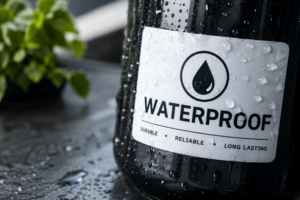
In wet environments, water is the primary cause of label
failure.
Paper labels absorb moisture, weakening the material and
affecting the printed surface. Ink can smudge or fade, reducing readability and
compromising important information.
Handling during production or transport increases exposure
to moisture, making the problem worse over time.
Materials used in wet conditions need to resist water
completely, maintaining both structure and print clarity even with repeated
exposure.
Synthetic materials are often preferred in these
environments because they provide significantly better moisture resistance than
standard paper labels.
Outdoor environments (weather, UV and temperature changes)
Outdoor conditions combine multiple stress factors.
Sunlight can cause colours to fade. Rain and humidity affect
both adhesion and material strength. Temperature changes create expansion and
contraction, which can weaken the bond between the label and the surface.
Standard labels are not designed to handle this level of
exposure.
Over time, they degrade, peel away, or become unreadable.
For outdoor applications, polyester materials are commonly
used because they are waterproof, weatherproof, and highly durable. These
materials are available with both permanent and removable adhesive options,
depending on how long the label needs to remain in place and the surface it’s
being applied to.
Materials selected for outdoor use need to maintain both
adhesion and print clarity despite constant exposure to changing environmental
conditions.
A practical failure example
A food business stores products in chilled conditions and
distributes them through a supply chain where packaging is repeatedly exposed
to moisture during handling and transport.
They use standard paper labels. At first, everything appears
fine. Labels are applied cleanly and look correct.
As condensation builds, the edges begin to lift. Some labels
come off entirely over time. Others remain attached but lose print clarity due
to moisture exposure.
Products need to be relabelled. Some are rejected. Branding
becomes inconsistent across batches.
The issue isn’t isolated. It’s built into the material
choice from the start.
Where businesses go wrong
Most issues stem from treating labels as a universal
solution.
One label type is used across multiple products and
environments, even when conditions vary significantly. Decisions are often
based on availability or cost rather than how the label needs to perform after
application.
Testing is also frequently limited or skipped entirely.
Labels are ordered in volume without being exposed to the
actual conditions they’ll face, meaning failures only appear once products are
already in circulation.
When material selection becomes critical
Once products are exposed to specific environmental
conditions, label performance becomes far less flexible.
The material, adhesive, and print method all need to align
with how the product is stored, handled, and transported.
Different environments require different solutions, whether
that means moisture-resistant synthetic materials for wet applications,
specialised deep freeze adhesives for frozen logistics, or weatherproof
polyester materials for long-term outdoor use.
Mercury Labels works with businesses to define those
requirements before production, selecting materials suited to the exact
conditions the label will face. That includes moisture resistance, temperature
tolerance, UV durability, and long-term adhesion performance.
The focus is not just on how the label looks when applied,
but how it performs throughout its entire lifecycle.
Quick material selection checklist
- The
environment the label will be exposed to - The
surface the label will be applied to - How long
the label needs to remain intact - Levels
of moisture, temperature change, or UV exposure - Whether
specialised adhesives are required for chilled or frozen conditions - Compatibility
between material and print method
Why the right material isn’t optional
Label failure in these environments isn’t random. It’s
predictable.
If the material doesn’t match the conditions, the label will
eventually fail. It may not happen immediately, but it will happen under
pressure.
Choosing the right label material isn’t simply about
upgrading quality.
It’s about ensuring the label performs exactly as it needs
to, for as long as it needs to.