
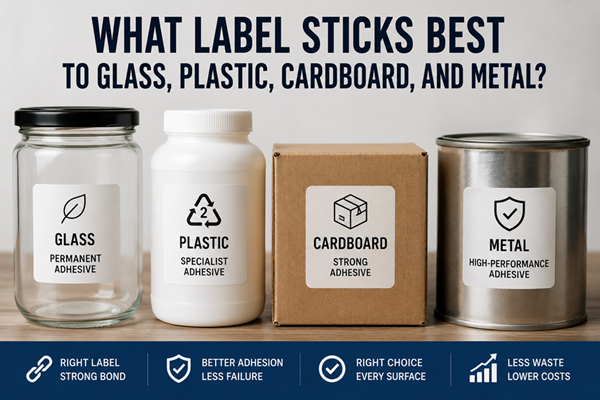
What Label Sticks Best to Glass, Plastic, Cardboard, and Metal?
Posted by : Mercury Labels Ltd on Wednesday, May 6, 2026 in Choosing Your Labels.
Most businesses don’t ask this question until something goes
wrong.
Labels peeling off products. Edges lifting in storage.
Barcodes becoming unreadable. Entire batches need to be relabelled.
At that point, the issue isn’t design or print quality. It’s
adhesion.
Different materials behave very differently, and choosing
the wrong label for the surface is one of the most common causes of product and
packaging failure. Getting this right early avoids wasted stock, returns, and
unnecessary rework.
Why labels fail on different surfaces
Adhesion isn’t universal. It depends on how the label
interacts with the surface it’s applied to.
Smooth materials like glass and metal tend to accept labels
more easily, but become problematic when moisture or temperature comes into
play. Plastics vary widely depending on their composition, with some actively
resisting adhesion. Cardboard introduces a different challenge, absorbing
adhesive rather than holding it on the surface.
Application conditions matter just as much. Dust, oils,
condensation, and temperature all affect how well a label bonds.
This is why a label that works perfectly in one situation
can fail completely in another.
Surface-by-surface breakdown
Glass
Glass is one of the easiest surfaces for labels to adhere
to.
It has high surface energy and a smooth finish, which allows
adhesives to bond effectively. In ideal conditions, most permanent labels will
stick well.
The problems start when temperature and moisture are
introduced.
Cold glass, particularly from refrigerated storage, often
develops condensation. If labels are applied at this stage, the adhesive bonds
to the moisture rather than the surface, leading to peeling or complete
failure.
A key option in these scenarios is glass removable labels, which
are designed to stay securely in place during use but still remove cleanly
without leaving any residue behind. Despite being removable, they still have
enough tack to ensure they do not fall off during storage, transport, or
handling.
Best approach:
- Apply labels to dry, room-temperature glass
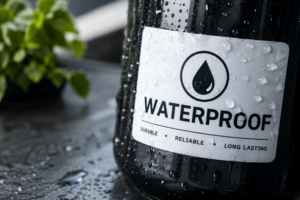
- Use waterproof materials where condensation is
unavoidable - Choose permanent adhesives for long-term use
- Consider glass removable labels when clean
removal and reliable adhesion are both required
Plastic
Plastic is where most adhesion issues occur.
The key difference is surface energy.
High surface energy plastics such as PET and PVC behave
similarly to glass. Labels generally adhere well with standard adhesives.
Low surface energy plastics such as HDPE and polypropylene
are far more difficult. These materials resist adhesion, causing labels to lift
at the edges or fail entirely.
This is a common issue in packaging for bottles, containers,
and consumer goods.
Best approach:
- Identify the plastic type before selecting
labels - Use specialist adhesives designed for low
surface energy materials - Test adhesion before committing to large print
runs
Cardboard
Cardboard introduces a different challenge.
Unlike glass or plastic, it’s porous. Instead of holding
adhesive on the surface, it absorbs it.
This can weaken the bond, especially if the material is
dusty or uneven. Recycled cardboard can be particularly inconsistent, making
adhesion less predictable.
However, cardboard also provides grip when the right
adhesive is used.
Best approach:
- Use strong, flexible adhesives that can bond
into the surface - Ensure the surface is clean and free from loose
fibres - Allow sufficient pressure during application for
proper bonding
Metal
Metal surfaces are smooth and generally suitable for strong
adhesion.
However, they are highly sensitive to temperature and
contamination.
Cold metal can reduce adhesive performance significantly,
especially in industrial or outdoor environments. Oils or residues from
manufacturing processes can also prevent proper bonding.
Best approach:
- Ensure surfaces are clean and free from oils
- Apply labels at suitable temperatures where
possible - Use high-performance adhesives for demanding
conditions
A practical example businesses run into
A drinks company labels glass bottles straight from
refrigerated storage.
The surface looks dry, but a thin layer of condensation is
present. Labels are applied immediately during packaging.
Within hours, edges begin to lift. By the time products
reach shelves, labels are peeling and misaligned.
The issue isn’t the label design or print quality.
It’s the application condition.
Where most label decisions go wrong
The most common mistake is choosing labels based on cost or
appearance rather than performance.
A label that looks identical can behave very differently
depending on the adhesive used. Without considering the surface and
environment, businesses often only discover issues after production.
Another issue is skipping testing. Ordering large volumes
without trialling labels on actual packaging materials increases the risk of
failure.
In practice, adhesion should be treated as a technical
requirement, not an afterthought.
Quick reference for common surfaces
- Glass → permanent adhesive, applied dry,
waterproof materials if needed - Plastic (PET/PVC) → standard adhesive usually
sufficient - Plastic (HDPE/PP) → specialist adhesive required
- Cardboard → strong, flexible adhesive suited to
porous surfaces - Metal → high-performance adhesive, temperature
considered
Choosing the right label starts before printing
Selecting the right label isn’t just about material. It
involves understanding the surface, the environment, and how the label will be
applied in real conditions.
Suppliers like Mercury Labels typically assess these factors
before recommending a solution, ensuring the adhesive and material match the
application rather than relying on a one-size-fits-all approach.
This reduces the risk of failure and avoids the cost of
reprints or relabelling.
The difference between a label that adheres properly and one that
does not is significant
Labels don’t fail randomly. They fail because the surface,
adhesive, or application conditions weren’t aligned.
When those factors are matched correctly, labels perform consistently,
products look professional, and operations run smoothly.
This isn’t a design choice.
It’s a performance decision that directly affects product
quality and cost.