
Thermal Labels vs. Inkjet Labels vs. Laser Labels: Which One Should Your Business Use?
Posted by : Mercury Labels Ltd on Friday, April 24, 2026 in Thermal Labels.
Most businesses
don’t compare label types out of curiosity.
They do it because
something isn’t working.
Labels are smudging
during handling. Prints are fading before products reach customers. Printers
are slowing down operations or failing under volume.
At that point, the
issue isn’t just the label. It’s the system behind it.
Choosing between
thermal, inkjet and laser labels isn’t about preference. It’s about selecting a
setup that matches how your business actually operates.
Suppliers like
Mercury Labels typically guide this decision by looking at print volume,
environment and application method before recommending a label type, because
the wrong combination leads to on-going problems, not one-off fixes.
What each label type actually means
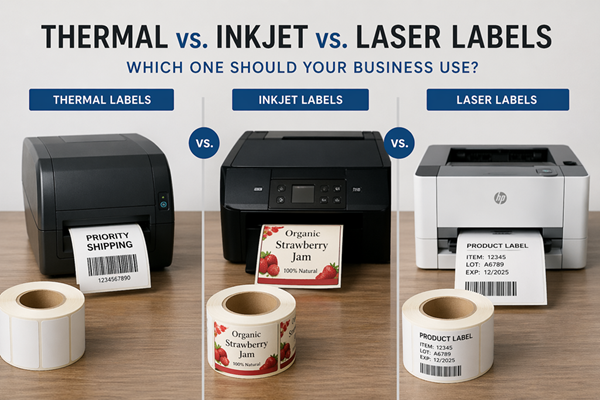
Thermal, inkjet and
laser labels aren’t interchangeable. Each relies on a different printing
process, which directly affects performance.
Thermal labels
use heat rather than ink. Direct thermal labels react to heat from the printer,
while thermal transfer uses a ribbon to create a more durable print.
Inkjet labels rely
on liquid ink applied to the surface. They’re commonly used with standard
office or desktop printers.
Laser labels use toner
fused onto the label using heat. These are typically produced through
office-based laser printers.
Understanding this
difference is what determines whether your labels perform properly or create
issues later.
How they compare in real business use
Print durability
Thermal labels vary
depending on the type used. Direct thermal labels can fade over time,
especially when exposed to heat or sunlight, while thermal transfer labels
offer stronger resistance and are better suited for long-term use.
Inkjet labels are
more vulnerable. Ink can smudge if exposed to moisture or friction unless the
material is specifically designed to absorb and protect it.
Laser labels
provide a more stable print than inkjet, but they are not inherently waterproof
and can still degrade in harsher environments.
Cost over time
Thermal systems
often involve a higher initial investment in equipment, but running costs are
lower because there is no need for ink in direct thermal setups.
Inkjet systems are
cheaper to start with, but ink costs accumulate quickly, especially at scale.
Frequent cartridge replacement becomes a hidden expense.
Laser printing sits
between the two. Toner lasts longer than ink, but the overall system is not
always designed for high-volume label production.
Speed and efficiency
Thermal printing is
built for speed. It’s widely used in logistics and warehousing because it can
produce large volumes of labels quickly and consistently.
Inkjet is slower
and more manual. It works for smaller batches but becomes inefficient as volume
increases.
Laser printers
offer moderate speed, but they are not optimised for continuous label
production, particularly in operational environments.
Best use cases
Thermal labels are
suited for shipping, barcoding, and high-volume applications where speed and
consistency matter.
Inkjet labels are
typically used for smaller runs, especially where colour printing is required
for branding or product presentations.
Laser labels are
more common in office settings, where labelling needs are occasional rather
than operational.
A common scenario businesses run into
An e-commerce
business begins by printing shipping labels using an inkjet printer. At low
volume, this approach works.
As order numbers
increase, problems start to appear. Labels smudge during handling, ink runs in
damp conditions, and printing becomes slower as batches grow.
The business
switches to thermal printing.
Immediately, labels
print faster, remain clear during transit, and reduce handling issues.
The change isn’t
cosmetic. It directly improves operations.
Where businesses choose the wrong system
Most mistakes
happen at the start.
Some businesses
choose based on what equipment they already have, using an office printer for
tasks it wasn’t designed to handle. Others focus on upfront cost, selecting
cheaper setups that become pricier over time.
Another common
issue is that businesses often ignore the environmental conditions to which
their labels will be exposed. During the decision process, people often
overlook the effects of heat, moisture, and friction on performance.
These decisions
don’t fail immediately. They fail over time, which makes them harder to trace
back to the original choice.
Quick decision guide
- High volume shipping or barcodes → thermal
- Long-term durability or harsh environments →
thermal transfer - Colour labels in small batches → inkjet
- Occasional office labelling → laser
Making the right choice for your setup
There isn’t a
single “best” label type.
The right choice
depends on how your business operates day to day.
This encompasses
the number of labels you print, the speed at which you require them, the
conditions they encounter, and the significance of durability post-application.
This is where
working with a specialist supplier becomes important. Mercury Labels supports businesses by
aligning label materials with the printing systems and environments they’re
actually used in, helping avoid mismatches that lead to wasted time and
materials.
The difference a correct setup makes
When the label type
matches the system, everything runs more smoothly.
Printing becomes
consistent. Labels hold up during handling and storage. Operational delays
caused by smudging, fading or reprinting are reduced.
Choosing between
thermal, inkjet and laser isn’t just a technical decision.
It’s a practical one that affects cost,
efficiency and reliability across your entire process.