
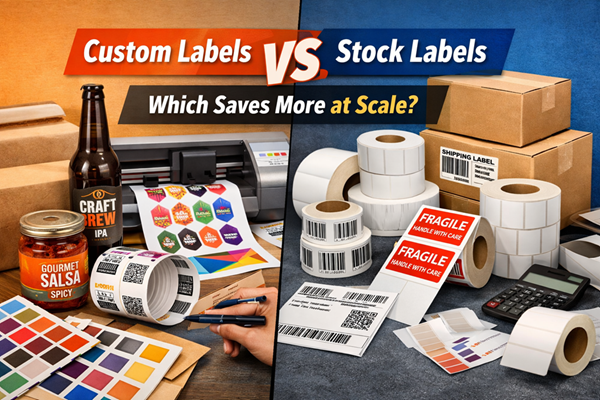
Custom Printed Labels vs. Standard Stock Labels: Which Saves More Money at Scale?
Posted by : Mercury Labels Ltd on Monday, April 20, 2026 in Choosing Your Labels.
Most businesses
start with stock labels for one reason.
They’re cheaper.
There is no need
for setup, design, or commitment. You buy what you need, apply them, and move
on.
Custom labels, on
the other hand, look like an investment. Custom labels have a higher unit cost,
require more planning, and are often viewed as something to consider later.
However, once
production scales, this reasoning begins to falter.
Because the real
cost isn’t what you pay for the label.
It’s what the label
costs your operation over time.
The Difference Between Stock and Custom Labels is What Businesses Refer
to
Stock labels are
pre-made, standard formats.
They come in fixed
sizes, materials, and adhesive types. They’re designed to work across a wide
range of applications, but not specifically tailored to yours.
Custom labels
are built around a specific use case.
That includes size,
material, adhesive, and print design. Everything is aligned to how the label
will actually be used in production, packaging, and distribution.
At low volume, both
can work.
At scale, the
differences become more visible.
1. Unit cost vs. total usage
Stock labels are
cheaper per unit.
That’s the main
reason businesses choose them early on.
But lower unit cost
doesn’t always translate to lower total cost. If labels don’t fit properly,
require repositioning, or don’t perform consistently, usage increases.
Custom labels cost
more per unit, but they’re designed to work correctly first time. That reduces
waste, repeat application, and unnecessary consumption.
Over time, total
usage becomes more important than unit price.
2. Application efficiency
Stock labels aren’t
designed for your exact product or packaging.
That creates small inefficiencies
during application. Labels may not align perfectly, require adjustment, or slow
down handling during packaging.
Individually, these
issues seem minor.
Across hundreds or
thousands of products, they add up.
Custom labels are
sized and formatted for the specific application. That allows for faster, more
consistent placement, especially in higher-volume environments.
The difference
shows up in time, not just materials.
3. Error and waste rates
Stock labels
introduce more variables.
If the size is
slightly off, positioning becomes inconsistent. If the adhesive isn’t suited to
the surface, labels may lift or fail over time.
These issues lead
to rework, relabelling, or in some cases, unusable stock.
Custom labels
reduce these risks by aligning material, adhesive, and format to the exact use
case.
Fewer errors means
less waste, and less waste reduces overall cost.
4. Branding and compliance impact
Stock labels often
require compromises.
You may need
separate labels for branding, barcodes, or compliance information. That creates
additional steps in your process and increases the chance of mistakes.
Custom labels
combine these elements into a single format.
Everything is
printed and positioned as required, reducing handling time and ensuring consistency
across products.
For businesses
dealing with regulated information or high-volume packaging, this approach
becomes a practical advantage rather than a design choice.
5. Scalability over time
Stock labels are
effective at the early stage.
They allow businesses
to move quickly without committing to a specific format.
As volume
increases, their limitations become more noticeable.
Handling slows
down. Errors increase. Processes become less efficient.
Custom labels,
while requiring more setup initially, scale more effectively. They support
consistent application, reduce friction, and maintain performance as volume
grows, which ultimately leads to improved efficiency and cost-effectiveness in
the long run.
This scenario is
where the cost balance shifts.
A comparison in real terms
Business A uses
stock labels.
They apply a basic
label for identification, then add a second label for branding and a third for
barcodes. Application takes longer, and positioning varies between products,
which can lead to inconsistencies in branding and identification across the
inventory.
Business B uses
custom printed labels.
All required
information is integrated into one label. Application is quicker, more
consistent, and requires fewer steps.
Over time, Business
B processes more products with fewer errors and less handling time.
The difference
isn’t just cost per label.
It’s how
efficiently the operation runs.
Where stock labels still make sense
Stock labels aren’t
wrong.
They’re useful in
specific situations.
Early-stage businesses,
low-volume production, or testing phases often benefit from the flexibility
they provide. They allow you to adjust quickly without committing to a
long-term solution.
The issue arises
when businesses continue using them beyond the point where they’re effective,
leading to increased costs and inefficiencies that can outweigh the initial
benefits.
Where cost is often miscalculated
Most businesses
focus on the visible cost.
The price of the
label itself.
What’s often missed
is everything around it.
Time spent applying
labels. Errors during packaging. Rework when labels fail or don’t align. Delays
caused by inefficient processes.
These costs don’t
appear on an invoice, but they affect the operation daily.
As volume
increases, they become more significant than the label price itself.
When custom labels become the more efficient option
As production
scales, inefficiencies become measurable.
At this stage, many
businesses move toward custom-printed labels to reduce handling times, improve
consistency, and minimise waste.
Mercury Labels
supports this transition by designing label solutions around the specific
requirements of each business. That includes material selection, adhesive
performance, and layout, ensuring labels function correctly within real operational
conditions.
The result is a
system that works more efficiently at scale, rather than one that needs
constant adjustment.
The real decision isn’t about labels
Choosing between
stock and custom labels isn’t just a product decision.
It’s a decision
about how your operation runs.
Stock labels
prioritise flexibility and low upfront cost.
Custom labels
prioritise efficiency, consistency, and long-term performance.
At small scale, the
difference is minimal.
At larger scale, it becomes the difference
between a process that works and one that constantly needs fixing.